

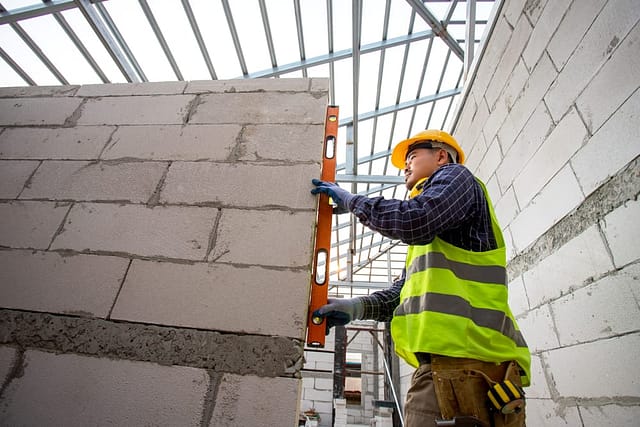

Have you ever thought about a building’s composition while standing in front of it? The smooth, poured walls, large gray blocks, and bricks all appear sturdy and long-lasting. It’s likely that you’ve heard the terms “masonry” and “concrete” used interchangeably, which frequently raises the question, “Is masonry concrete?”
You wouldn’t be the only one who has this question; it is a common source of confusion. A simple yes/no response is not as interesting as the answer. We can better appreciate the skill that goes into every building project and the structures around us when we are aware of the key distinctions.
Understanding Masonry: How It Works and Why It Matters
Let’s start by discussing masonry. Consider it the art of constructing by assembling individual parts. Building with LEGOs is a good analogy; you take small blocks and stack them to create something larger and more intricate.
The idea behind masonry work is similar, but it’s done on a much bigger and more permanent scale. These discrete units can be anything from manufactured brick or concrete blocks to locally occurring natural stones. The secret is that these disparate parts are held together by a binding substance known as mortar. For expert craftsmanship in assembling durable structures, modern masonry and stonework in Dallas, TX, by Decathlon Construction combines skilled techniques with quality materials to bring every project to life.
The paste-like substance found in the spaces between bricks is called mortar. It is a cement, sand, and water mixture that serves as a glue to join the units and close the spaces between them. Thus, a masonry structure is a complete system consisting of the mortar, the masonry units, and occasionally reinforcing steel for added strength. Whether local or imported stones are used, the choice of material has a big impact on the finished look. A skilled masonry contractor must have extraordinary precision when working with smaller stone mediums. In the end, masonry generally refers to the construction process using separate units and mortar.
Now, What About Concrete?
Unlike masonry, concrete is not constructed from separate parts. Rather, it begins as a liquid that can be poured into shapes to form nearly any shape. Because it solidifies into a long-lasting mass, it is sometimes referred to as “liquid stone.”
Main Ingredients:
-Aggregate: Typically a mix of sand, gravel, and crushed stone.
-Cement: Usually Portland cement, which acts as the binder.
-Water: Added to start a chemical reaction called hydration, which hardens the mixture.
Strength Characteristics:
-Compressive Strength: Excellent at handling compression (squeezing).
-Tensile Weakness: Less effective against pulling or bending forces.
-Solution: Reinforced concrete incorporates steel bars (rebar) to increase tensile strength.
Versatility: Can be poured on-site or made into precast elements like beams, panels, or blocks in a factory setting.
Construction Benefits: Precast concrete speeds up projects and ensures uniform quality.
The Big Question: So, is Masonry Concrete?
We return to our main question: Is masonry just another word for concrete? The answer is no, they are not the same thing. Concrete is a particular material that is usually poured into large forms and left to harden, whereas masonry is a construction technique that uses individual units.
In the construction industry, there are two different entities. The reason for the confusion is that concrete is used to make one of the most popular masonry units. The big, gray blocks that are frequently used for garages, foundations, and commercial construction will probably be familiar to you.
Officially, these are known as concrete masonry units, or CMUs. Therefore, concrete can be used as the building block for masonry. For this reason, people occasionally use the term “masonry concrete” or confuse the two terms. Although you are using masonry for your construction, the material you are stacking is actually concrete.
Making this distinction is crucial. One way to look at it is that while not all masonry uses concrete blocks, all concrete blocks can be used for masonry work. Brick, stone, and other materials can also be used in masonry, so the terms are not synonymous. For reliable results on projects involving concrete blocks and masonry, explore the best concrete services in Dallas, TX, to get professional guidance and quality workmanship.
Diving Into Concrete Masonry Units (CMUs)
Let’s take a closer look at concrete blocks because they are so widely used. Modern construction relies heavily on these blocks, which form the basis of concrete block masonry. They are widely used because they are uniform in size, strong, and reasonably priced to produce, all of which make it much simpler to construct a straight, sturdy block wall.
These blocks are more than just straightforward, solid concrete rectangles. The majority have hollow cores, or centers, which have a few key functions. Masons can handle the blocks more easily and with less fatigue thanks to the cores, which also boost efficiency on the job site.
In addition to increasing the wall’s insulation value, these hollow spaces offer a practical path for plumbing or electrical wiring. These cores can be filled with grout and steel reinforcement for increased strength, particularly in walls that must support large loads or withstand lateral forces. This creates a powerful, reinforced masonry system.
How Are CMUs Made?
CMUs are constructed using a dry-cast or zero-slump mix, as opposed to the poured concrete you see for a sidewalk. This mixture has a very stiff consistency because it contains a lot less water. To compact this material tightly, it is pressed into a mold, similar to a concrete brick form, and vibrates vigorously.
Millions of identical blocks can be produced using this highly automated manufacturing process, guaranteeing quality control for any building project. Masons use strong masonry saws to cut the blocks to the exact size required for corners or around openings when on-site adjustments are required. It takes a steady hand to make these cuts.
Types of Concrete Blocks
Concrete blocks come in a variety of sizes and shapes to suit a range of applications. You can better understand where and why they are used if you are aware of some of the common types. These blocks are used in a variety of concrete projects, both residential and commercial.
| Block Type | Description | Common Use |
| Hollow Blocks (Stretcher Blocks) | Standard rectangular block with two or three hollow cores. | Used for building most walls, laid in a running bond pattern. |
| Solid Blocks | Completely solid with no cores, making them much heavier. | Used where extra strength, durability, or soundproofing is needed. |
| Lintel Blocks | Have a U-shaped channel on top to hold rebar and grout. | Placed over door and window openings to support the load above. |
| Paving Blocks (Pavers) | Solid, flat blocks designed to interlock with each other. | Used for creating driveways, patios, and walkways. |
| Corner Blocks | Have one flat, finished end for creating clean corners on a wall. | Used at the ends and corners of walls for a finished look. |
Concrete vs. Masonry: A Head-to-Head Comparison
Let’s examine masonry and cast-in-place concrete side by side to further clarify the differences. You can better understand each one’s function in construction by recognizing their main distinctions. They were picked for quite different reasons, and each has their own advantages.
The installation process is one major distinction. Building concrete forms, setting rebar, and then pouring a wet mix are all steps in the concrete construction process. It is a task for skilled concrete contractors and may be quicker for big, monolithic structures like floors or foundations.
In contrast, masonry construction requires the expert work of meticulously laying each unit one at a time. Although it takes more work, this method produces a unique, textured appearance that is challenging to duplicate. Another significant difference between the two is the final appearance.
Although it can be colored or stamped, poured concrete frequently has a smooth, industrial appearance. From the traditional appearance of red brick to the rough allure of natural stone, masonry offers a vast array of aesthetic options. For this reason, masonry is frequently used for a building’s visible external faces.
| Feature | Masonry (e.g., Brick Wall) | Poured Concrete (e.g., Concrete Wall) |
| Composition | Individual units (brick, stone, CMU) held by mortar. | A single mass of aggregate, cement, and water. |
| Installation | Units are laid and stacked by hand. Labor-intensive. | Poured into forms and cures on-site. Can be faster for large areas. |
| Strength | Good compressive strength. Weaker at mortar joints. | Excellent compressive strength. Weak tensile strength unless reinforced. |
| Appearance | Varied textures and colors. Aesthetically pleasing. | Typically smooth and industrial. Can be finished in many ways. |
| Skill Required | Requires skilled masonry contractors for quality work. | Requires skilled formwork carpenters and concrete finishers. |
Where Do You See Masonry and Concrete Working Together?
Concrete and masonry are not competitors, despite their differences. They frequently collaborate on the same construction project and are more akin to teammates. The advantages of both are commonly combined in modern concrete masonry construction to produce robust and effective structures.
Once you start looking, you’ll see this partnership everywhere. A normal house foundation is an ideal illustration. In order to distribute the weight of the house over a greater area of soil, the footing, or bottom portion, is nearly always composed of poured concrete. Builders frequently use concrete masonry units to build the foundation walls on top of this concrete footing.
Large commercial buildings are another typical sight. The skeleton of these buildings may consist of reinforced concrete floors and columns that carry out the majority of the work. To give the building a more appealing finish, the outside walls may then be made of brick or stone masonry.
Another area where this partnership excels is retaining walls. The wall itself is constructed from interlocking concrete blocks, with a concrete footing that has been poured to provide a stable base. This combined strategy is clever engineering that makes use of both systems’ strongest points.
According to the NC Department of Labor, concrete and masonry construction poses several physical hazards; including falls from heights, electrocution, being caught between objects, and being struck by materials, as well as health risks from silica dust, skin contact with uncured concrete, and high noise levels from power tools. Professionals from Decathlon Construction follow strict safety protocols and implement best practices on every job site to protect workers and maintain a safe, compliant work environment.
Advantages of Using Concrete in Masonry Construction

There are many benefits to using concrete blocks for masonry. They are among the most popular building materials worldwide for a reason. Because of their qualities, they are a sensible option for a wide variety of projects, ranging from a straightforward garden wall to a multi-story structure.
To begin with, concrete masonry constructions are extremely robust and long-lasting. Because it resists deterioration and is immune to termites and other pests, a well-constructed CMU wall can endure for generations with minimal upkeep. It is a wise investment because of its longevity.
They are also very resistant to fire. Because concrete doesn’t burn, CMU walls have an extremely high fire resistance rating. A major safety benefit of any wall construction is that it can help slow the spread of a fire and give people vital time to safely leave a building.
Concrete masonry is strong, durable, and versatile, with reinforced walls able to withstand extreme events and designed for compressive strengths of 2,000 psi or more according to the International Masonry Institute. Its dense composition provides thermal mass, sound dampening, and excellent fire resistance, with walls achieving up to a 4-hour rating. Lightweight units further reduce structural load while enhancing insulation, sound control, and fire performance, making concrete masonry a practical choice for modern construction.
What are the Downsides?
No building material is flawless, of course. A few disadvantages of concrete masonry affect whether it’s the best option for a given project. Architects and builders should be aware of these limitations.
Water resistance is the main problem. Because concrete is porous, improperly treated concrete may absorb water. Without being sealed or waterproofed, moisture can seep through a CMU wall, causing dampness, the growth of mold, and damage from freeze-thaw cycles in cold climates.
Beyond that, building CMU requires a lot of labor. One by one, the heavy blocks must be manually placed. Compared to other construction methods, this can result in higher labor costs and longer project timelines because it requires a lot of physical labor from skilled masons.
How Masonry and Concrete Affect Your Building Projects
Let’s return to our initial question. Although concrete is a material and masonry is a building technique, the concrete masonry unit greatly overlaps the two categories.
One product of concrete used in the masonry process is the unassuming concrete block. While masonry builds walls piece by piece using individual blocks or stones, concrete itself can be poured into large forms for slabs and foundations. In the construction industry, both are fundamental techniques that frequently combine to produce the sturdy buildings we depend on on a daily basis.
Understanding the difference between masonry and concrete reveals the skill behind every structure. The next time you see a block wall, you’ll see masonry and concrete working together. Decathlon Construction’s experts can help homeowners and business owners plan and execute their next project with precision and quality. Get in touch today to start building with confidence.